Present and future
In writing this book, my intention was to describe what we know about the anatomy and physiology of the visual system pathways down to the striate cortex. The information we now have is, in essence, only the first fruits of our attempts to understand the physiological basis of perception, only the beginning of a fascinating story, the next chapters of which are just being scanned; from an average distance we can only see the main mountain ranges, their ends are beyond visibility.
The striate cortex is just the first of more than a dozen separate visual areas, each representing the entire visual field. Together, these areas form a patchwork quilt that covers the occipital cortex and extends forward into the posterior temporal and posterior parietal cortices. Starting with the striate cortex, each zone supplies information to two or more overlying (in the sense of a hierarchy) zones, and the connections between them are topographically organized so that any given zone, like the striate cortex, contains an ordered representation of the visual field. Ascending connections are thought to carry visual information from one area to another for further processing. Our task is to figure out for each of these areas how information is processed here - the same task that we faced earlier, wondering what the striate cortex does with the information received from the geniculate body.
Although we have only recently learned how numerous these visual areas are, evidence is already accumulating about the connections and single-cell physiology of some of them. Just as area 17 is a mosaic of two sets of areas, bubble and non-bubble, the next visual area, field 18, or visual area 2, consists of three sets. Unlike bubbles and non-bubbles, which form, as it were, islands in the ocean, the mosaic of field 18 has the shape of parallel stripes. In the system of these strips we find an amazing division of functions. In the complex of thick stripes, most cells are quite sensitive to the relative horizontal position of stimuli presented to both eyes, as described in Chapter 7; hence we conclude that this thick-striped division is related, at least in part, to stereoscopic vision. The cells of the second set, located in thin stripes, lack orientation selectivity and often demonstrate specific color reactions. The cells of the third population, located in the pale stripes, are orientation-selective and mostly respond to the ends of the lines. Thus, the three sets of subdivisions that make up field 18 are apparently associated with stereopsis, color and form.
A similar division of functions exists in the areas located above area 18, but here each area as a whole appears to perform only one or perhaps two visual functions. An area called MT (from middle temporal gyrus) is associated with motion perception and stereopsis, while area V4 is probably mainly associated with color. In this way we can distinguish between two processes going hand in hand. The first of them is hierarchical in nature. To solve the various visual problems outlined in previous chapters relating to color, stereopsis, motion and shape, one area after another is involved in information processing, and in this series the degree of abstraction and the complexity of display increase. The second process is the divergence of pathways. Apparently, the tasks being solved require such different strategies and neural mechanisms that it becomes more profitable to distribute them between separate channels.
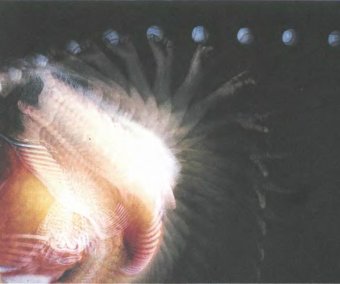
Rice. 151. A baseball batter turns toward a ball moving toward him at about 100 miles per hour; at such a high speed, the entire flight of the ball lasts about a second. The result of the player's actions is determined by a few millimeters of misalignment. Success or failure depends on the functioning of the visual structures—those discussed in this book and numerous others located at higher levels of the visual system—as well as on the motor structures, including the motor cortex, cerebellum, brain stem, and spinal cord.
This surprising tendency to process features such as shape, color, and motion in separate brain structures immediately raises the question: How does all this information ultimately come together when perceiving, say, a bouncing red ball? It is clear that it must come together somewhere - if only in the motor nerves that control the act of grasping. Where it gathers and how it happens, we have no idea.
This is where we are now, in 1987, in our step-by-step analysis of the visual pathway. In terms of the number of synapses (about 8 or 10) and the complexity of the transformations, the path from the rods and cones of the retina to areas MT or visual area 2 in the cortex may seem long, but the path from processes such as responses to orientation, line ends, disparity, or the ratio of opponent colors to the recognition of any shapes we perceive in everyday life is undoubtedly much longer. We are far from understanding the perception of objects, even such relatively simple ones as a circle, a triangle, or the letter A—we are far from even being able to formulate plausible hypotheses about them.
We should not feel much surprise or embarrassment at our ignorance of these mysteries. Artificial intelligence (AI) researchers are struggling to create a machine that can compete with the brain at specialized tasks such as reading handwriting, driving a car, or recognizing faces. They showed, however, that solving any of these problems involves enormous theoretical difficulties. The point is not that these difficulties are insurmountable - after all, the brain clearly copes with them; It's more about how the brain's methods can't be simple: in AI parlance, problems are said to be "non-trivial." So, the brain solves non-trivial problems. The surprising thing is that he solves not two or three, but thousands of such problems.
After a lecture, when it comes time to answer questions, a sensory physiologist or psychologist is often asked what the most plausible guess is as to how visual objects are recognized. Do cells, as they move to more central levels, become more and more specialized, so that at some level there might be cells that respond to the face of one single specific person—for example, someone's grandmother? This representation, called granny cell theory can hardly be taken seriously. Can we find separate cages for grandma smiling, crying or sewing? Or individual cells reflecting the concept or definition of “grandmother” - that it is the mother of a mother or the mother of a person’s father? And if we did have granny cells, what then? Where would they send their output signals?
An alternative is the assumption that a given object activates a certain group of cells - a “neural ensemble”, each member of which may also belong to other ensembles. Since it is known that the destruction of a small area of the brain does not usually lead to the disappearance of certain memories, we have to assume that the cells of one ensemble are not concentrated in one cortical zone, but are scattered over many zones. Thus, “grandmother sewing” must correspond to a larger ensemble that includes the grandmother by definition, the grandmother’s face, and the sewing process.
It is clear that coming up with a way to experimentally test such ideas is not easy. Even in striate cortex, it is not easy to record single-cell responses and make sense of the results; it is all the more difficult to imagine how one can comprehend the work of a cell that is part of perhaps a hundred ensembles, each of which contains a thousand cells. Having once attempted to record the activity of three cells simultaneously and understand their combined role in the daily life of an animal, I can only admire the efforts of those who hope to create electrode systems to simultaneously record impulses in hundreds of cells. But now we are getting used to dealing with tasks, the difficulty of which seemed insurmountable just yesterday.
The current case for vague ideas about cellular assemblies has been open for a long time, and it continues to receive evidence of the presence of cortical areas specialized for the perception of faces. The group of Charles Gross from Princeton discovered cells in the monkey brain in one of the visual areas of the temporal lobe that seemed to selectively respond to faces. People with damage to a certain area in the lower region of the occipital lobe often lose the ability to recognize faces, including even the faces of close relatives. Antonio Damasio of the University of Iowa suggested that these patients are unable to recognize not only faces, but also a broader class of objects that includes faces. He describes a woman who, in addition to faces, also did not recognize individual cars. She could distinguish a car from a truck, but when looking for her own car in a parking lot, she was forced to walk around rows of cars and read their license plates, indicating that both her vision and her ability to read license plates were intact.
Constructing speculative hypotheses can be a lot of fun, but when can we really hope to get answers to some of the questions related to perception? More than 35 years have passed since Kuffler studied the properties of retinal ganglion cells. During this time, our understanding of the complexity of the visual pathways and the range of problems affecting perception has changed radically. We realized that the discovery of center-periphery receptive fields and orientation-selective cells are just two steps in solving a puzzle that contains hundreds of similar steps. The brain, even just in terms of vision, is designed to perform many tasks, and millions of years of evolution have led to the development of some very ingenious solutions. Through hard work we may come to understand any small part of them, but we are unlikely to be able to understand everything. It would be equally unrealistic to believe that we will ever be able to understand the complex workings of each of the millions of proteins that exist in our bodies. From a philosophical standpoint, however, it is important to have at least a few examples (whether we are talking about neural structures or proteins) that we understand well: our ability to unravel even a small part of the processes associated with life - or with perception, thinking, emotions - tells us that a complete understanding fundamentally it is possible that we do not need to appeal to mystical life forces or to the soul.
Some people may fear that this kind of materialistic concept, which regards the brain as some kind of supermachine, will take the charm out of our lives and turn us away from spiritual values. This is akin to the fear that knowledge of human anatomy will prevent us from admiring the shape of the human body. Artists and doctors know that the opposite is true. The problem here is linguistic: if by car call something with rivets, ratchets and gears, it really does sound unromantic. But what I mean by by car any object that performs its functions in accordance with the laws of physics, an object that we can ultimately understand in exactly the same way as we understand the operation of a printing press. I believe that the brain is such an object.
Should we worry about the possible dire consequences of understanding the mechanisms of the brain, analogous to the consequences of understanding the atom? Should we be concerned about the CIA reading or monitoring our thoughts? I see no reason to suffer from insomnia over this, at least in the coming century. It should be obvious from all the preceding chapters of this book that reading or manipulating minds using advances in neuroscience is about as feasible as taking a weekend trip to the Andromeda galaxy and back. But even if thought control were possible in principle, preventing or curing millions of schizophrenic sufferers should be an easy task by comparison. I'd rather take the risk and continue researching.
We may soon face a different kind of problem: how to reconcile some of our most cherished and deeply held beliefs with new knowledge about the brain. In 1983, the Roman Catholic Church officially declared the acceptability of the physics and cosmology promulgated by Galileo 350 years earlier. Today, our judges, politicians, and publishers are faced with a similar problem as schoolchildren learn facts about evolution and molecular biology. If spirit and soul are to neurobiology what the heavens are to astronomy and creation is to biology, then a third revolution in minds can be expected in the not-too-distant future. We should not, however, smugly regard all this as a manifestation of the struggle between the wisdom of science and religious ignorance. If people tend to hold on to certain beliefs, then it is reasonable to assume that the evolution of our brains facilitated this tendency for reasons related to survival. Abandoning old beliefs or myths and replacing them with a scientific worldview should not be done hastily or by decree. But I think we will eventually have to modify our beliefs and make room in them for the facts that our brains have allowed us to establish by experiment and deduction: The Earth is round; it revolves around the Sun; living things evolve; life can be explained by the fantastically complex interaction of molecules; and thought will one day be understood as a function of fantastically complex systems of neural connections.
The potential benefits of brain cognition extend beyond the treatment and prevention of neurological and psychiatric diseases. It should also affect areas such as education, where we are also trying to influence the brain. So can't we teach better if we know the object we want to influence? Possible benefits even extend to art, music, sports and social relations. Everything we do depends on our brain.
Having said all this, I still have to admit that the strongest motivating factor for me, and, I believe, for most of my colleagues, is pure curiosity about the workings of the most complex structure now known.
Eye, brain, vision